Just Wake Up! Bringing your personality into line with your essence. Bhagavad-Gita of Inner Courage by Prof. Kev Nair
The Bhagavad Gita: The sole secret of inner peace.
Rave Reviews | Free Bhagavad-Gita Downloads | Bhagavad Gita Quotes | About Prof. Kev Nair | Buy NOW!
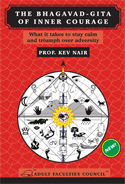
THE BHAGAVAD GITA OF INNER COURAGE by Prof. Kev Nair
Bookmark and Share
 
Home
 
Prof. Kev Nair's
Bhagavad Gita
What is the
Bhagavad Gita?
A unified whole
Singleness of focus
Poetic quality
Faithful translation
Full of new insights
Reader-oriented
The Voice of sanity
An enjoyable read
A Non-sectarian work
Prof. Kev Nair's Bhagavad Gita Chakra
 
Inside Prof. Kev Nair's
Bhagavad Gita
Table of Contents
Preface
Sample verses
 
Prof. Kev Nair
About Prof. Kev Nair
Other Books
by Prof. Nair
Talks on the Bhagavad Gita
 
How to buy
How to order
Mode of payment
Despatch of books
 
Contact us
 
Other Websites
fluentzy.com
fluencybookz.com
fluentenglish.com
 
English Fluency Lexicons by
Prof. Kev Nair
The Complete Fluency Words
Details...
A Dictionary of
Fluency Word Clusters

Details...
A Dictionary of
Essential Fluency Phrases

Details...
A Dictionary of
Active Fluency Combinations

Details...
Comprehensive Adjectival Fluency Dictionary
Details...
Prof. Kev Nair's Narrative Fluency Dictionary Narrative Fluency Dictionary
Details...
Core Fluency Thesaurus
Details...
Thesaurus
of Phrasal Verbs

Details...
Thesaurus
of Descriptive English

Details...

CATALOGUE
Catalogue, Fluency Dictionaries, Free Download
FREE Download!
There's a great offer inside the Calalogue!
 
  Justwakeup.com > Bhagavad Gita > Bhagavad Gita Quotes


Bhagavad Gita Quotes

All quotes on this webpage, Copyright © Kev Nair 2009.

Today's inspirational quote

• Mentally renounce all your actions to the Oppositeless. Make that pure spirit your highest goal. This is discipline of prudence.
- See Bhagavad Gita,
18.57.

• When you do everything you do as a sacrifice to cling to the Oppositeless, you’ll be freed from all bonds of action. You’re then truly focused on the Oppositeless. And you’re engaged in renouncing desires for everything else. And you reach the Oppositeless.
- See Bhagavad Gita,
9.28.

• Whatever you do, eat, sacrifice or give, whatever penance you do -- do all that as offerings to the pure spirit, the Oppositeless.
- See Bhagavad Gita,
9.27.

• Bow down to the pure spirit. Make that spirit your highest goal. Remain focused in this way. And you reach that pure spirit.
- See Bhagavad Gita,
9.34.

• Focus your mind on the totally liberated spirit. Remain devoted to that pure spirit. Offer all your sacrifices to that spirit.
- See Bhagavad Gita,
9.34.

• Follow the law of sacred duty. Stay intent on uniting yourself with the totally liberated spirit. You then achieve liberation.
- See Bhagavad Gita,
12.20.

• Sacrifices and penance unite you with the totally liberated spirit -- the world’s Lord and the friend of all. This knowledge is peace.
- See Bhagavad Gita,
5.29.

• Fix your gaze between your eyebrows. Make your in-breath and out-breath even -- and make them pass smoothly up and down your nostrils. You’ll now find it easier to stop your thoughts about objects of sense -- and so your desires and emotions.
- See Bhagavad Gita,
5.27.

• You’ll be able to drop thoughts, desires and emotions when you remain absolutely intent on liberation from them all.
- See Bhagavad Gita,
5.28.

• Remain focused with your whole being -- senses, mind and prudence -- intent on liberation from thoughts, desires and emotions.
- See Bhagavad Gita,
5.28.

• Don’t stay occupied with thoughts; but be keenly aware of them. You’re then free of being controlled by attachments, and so by desires and so by anger, and so by delusion. And you remain controlled by self-knowledge. Your prudence is now sanity-inspired.
- See Bhagavad Gita,
2.62-63.

• Learn all about the Oppositeless. Then when you give up your attachment to the body-mind complex, you're one with the Oppositeless.
- See Bhagavad Gita,
4.9.

• The Oppositeless protects those who obey the law of sacred duty and destroys those who flout it -- and thus restores the rule of law.
- See Bhagavad Gita,
4.8.

• Whenever the sacred law declines and lawlessness is on the increase, the Oppositeless acts as prudence and restores the sacred law .
- See Bhagavad Gita,
4.7.

• To maintain peace in their minds and peace outside, everyone has a duty to endure emotional opposites -- instead of giving in to them. From time to time, this law of sacred duty declines, and the rule of lawlessness begins to prevail and spread.
- See Bhagavad Gita,
4.7.

• Inner discipline is the state of staying focused, controlled by prudence. In that state, you’re free of all bonds of actions.
- See Bhagavad Gita,
2.39.

• Those who worship anything other than freedom outside all prisons are unwise. Their reward is transient and limited.
- See Bhagavad Gita,
7.23.

• Prisoners who worship the best things in prison get those best things. Prisoners who dream of better/worse prisons reach those prisons. But prisoners who worship a life of freedom outside all prisons achieve that freedom. And this freedom, only they achieve.
- See Bhagavad Gita,
9.25.

• The purpose of your life here is to turn into a person of prudence. Knowledge of the Supreme Oppositeless makes you become one.
- See Bhagavad Gita,
15.20.

• Desires opposed to your sacred duty sap your strength -- inner and outer -- and make it become limited.
- See Bhagavad Gita,
7.11.

• Your sacred duty is to free yourself from the clutches of emotional opposites. Don’t entertain any desire opposed to this duty.
- See Bhagavad Gita,
7.11.

• Fruits of actions based on the Oppositeless will not torment you. But fruits of actions based on emotional opposites will.
- See Bhagavad Gita,
14.16.

• Once you achieve impartiality, you meet everything that comes your way without exulting in triumphs & without hating misfortunes.
- See Bhagavad Gita,
2.57.

• One who follows the Oppositeless, and not the emotional opposites, has no partiality for any kind of event or result.
- See Bhagavad Gita,
2.57.

• To cling to the Oppositeless, your mind must be free. So be prudent: Don’t be attached to or hostile to anyone or anything.
- See Bhagavad Gita,
11.55.

• Let everything you do have a single motive: To cling to the Oppositeless. Then you’re free of all fears and sufferings.
- See Bhagavad Gita,
11.55.

• Once you acquire true self-knowledge, even the cruelest of acts imaginable that you do, as part of your duty, can’t torment you.
- See Bhagavad Gita,
18.17.

• Stay focussed by prudence -- knowledge of the self, the Oppositeless. Then neither evil actions nor good actions can torment you.
- See Bhagavad Gita,
2.50.

• Yoga, the inner discipline, is the skill in action -- action based on self-knowledge, prudence directed towards the Oppositeless.
- See Bhagavad Gita,
2.50.

• Yoga, the inner discipline, is nothing but the equal-mindedness towards success and failure - and towards other pairs of opposites.
- See Bhagavad Gita,
2.48.

• The disconnection of the connection with pain makes you equal-minded towards success and failure (and towards other opposites).
- See Bhagavad Gita, 6.23
, 2.48.

• The disconnection of the connection with pain is yoga, inner discipline. Practise it with resolve. And without giving in to despair.
- See Bhagavad Gita, 6.23
.

• The moment you plant yourself on the Oppositeless, there’s your total disconnection from every pain.
- See Bhagavad Gita, 6.23
.

• Learn the skill of planting yourself on your true self, the Oppositeless. No gain is greater -- and nothing can touch you then.
- See Bhagavad Gita, 6.22
.

• Only self-knowledge can illuminate the Oppositeless, common to all. Once you see It, you cling to It. Not to emotional opposites.
- See Bhagavad Gita, 15.6
.

• Once you’re at one with your true self, the Oppositeless, nothing can make you stir from there. Not even unbearable sorrow.
- See Bhagavad Gita, 6.21-22
.

• Cling to prudence; not to emotional opposites. You’re then at one with the self, the Oppositeless, the source of infinite joy.
- See Bhagavad Gita, 6.21-22
.

• Followers of emotional opposites are without prudence, one-pointedness. So they’re plagued by countless thoughts, many-pointed.
- See Bhagavad Gita, 2.41
.

• Prudence is the resolve based on knowledge of the Oppositeless self. It’s single, one-pointed, directed towards the Oppositeless.
- See Bhagavad Gita, 2.41
.

• The infinite joy beyond pleasures can be grasped only by prudence -- the one-pointed wisdom. Not by the mind or by other senses.
- See Bhagavad Gita, 6.21
.

• Senses can let you experience only the pleasures that events and things bring. Not the endless, infinite joy beyond these pleasures.
- See Bhagavad Gita, 6.21
.

• Cling to the detached state (of tranquility), the state focussed on the Oppositeless, the home of endless, supreme joy. Not to pleasures that events and things bring. These pleasures are a source of misery -- because they’ll come to an end sooner or later.
- See Bhagavad Gita, 5.21-22
.

• When you can stop looking at events according to emotional opposites, you’ve achieved detachment. You’re then focussed on the Oppositeless that is the same in all. In time, the detached state (of tranquility) liberates you into a higher state of endless joy.
- See Bhagavad Gita, 5.21
.

• What’s important is not what happens or what doesn’t -- pleasurable or painful. What’s important is this alone: Understand this truth fully. This understanding helps you to remain unruffled -- no matter what happens and what doesn’t. And to do your duty effectively.
- See Bhagavad Gita, 14.22-23
.

• When you don’t give in to emotional opposites and base your actions on the state beyond these opposites, all your inner faculties are firm and free of delusions. And no pleasurable events (or thoughts) and no painful events (or thoughts) can affect you.
- See Bhagavad Gita, 5.20
.

• Unlike emotional opposites, the Oppositeless is the same and equable forever. It never changes into an opposite state -- non-still state. Be wise and stop giving in to emotional opposites. You then reach this unmoving, unaffectable state of the Oppositeless.
- See Bhagavad Gita, 5.19
.

• The emotional opposites that arise and die differ from individual to individual. But the state beyond these emotional opposites is the same in everyone -- from the wisest to the stupidest. Once you realize this truth, you become a wise person too.
- See Bhagavad Gita, 5.18
.

• Many find happiness in sleep, laziness and negligence. They’re those who can’t tell apart emotional opposites and the oppositeless state beyond. This ignorance-based happiness deludes them at first and in the consequences. And they cling to sleep, laziness and negligence.
- See Bhagavad Gita, 18.39
.

• Thoughts, events and rewards also bring you happiness. But it’s based on your passion for emotional opposites (and not for the oppositeless). This event-dependent happiness is not true happiness. It’s nectar at first, but poison in the end. Don’t be attached to it.
- See Bhagavad Gita, 18.38
.

• When you give up attachment to rewards, you come to experience true joy, sanity-based happiness: Poison at first, but nectar in the end. This joy (true joy) comes from a quiet mind: A mind disciplined by pure prudence, prudence set on your true, oppositeless self.
- See Bhagavad Gita, 18.37
.

• Give up attachment to fictional and real-life rewards. And your suffering stops. But this takes strict mental discipline.
- See Bhagavad Gita, 18.36
.

NOTE: We have displayed only a few of the latest Bhagavad Gita quotes from Prof. Kev Nair on this webpage. To see all previous quotes, please visit Prof. Kev Nair's Twitter page.


   Prof. Kev Nair

• “One of the world’s most respected English language scholars... Perhaps more innovative in method than Roget and more modern in approach than Fowler, Prof. Kev Nair is... one of the foremost Indian scholars who wield great influence on the thinking of the English-educated people around the world.”
– General Knowledge Today.

• “If the world’s first thesaurus was brought out by a doctor, Dr. Peter Mark Roget, the world’s first fluency lexicon was brought out by a lawyer, Prof. Kev Nair.”
Competition Success Review.

• “His students are spread across 35 countries; highly educated, well-placed professionals turn to him for help...”
– The New Indian Express.

• “Nair was the first person in the world to give shape to the area of study now known as ‘English fluency development’ and to systematize it into a distinct teachable subject... So he is better known as the father of fluency development.”
– General Knowledge Today
.

• “Prof. Kev Nair is regarded the world over as the father of fluency lexicography... Fluency lexicography came into existence as a separate branch of dictionary writing with the publication of Prof. Nair’s Dictionary of Active Fluency Combinations in 1986.”
– Competition Success Review.

• “An eminent scholar of international repute and a renowned English language lexicographer”
– The New Sunday Express.

• “A towering English language expert”
– Competition Success Review.

• “There is an air of enormous authority and dignity around all Prof. Nair’s works, each of which is a magnificent blend of scholarship and practical common sense.”
– Competition Success Review.


Bhagavad-Gita of Inner Courage
Buy Now
 
"Extensive research on the content, language used in translations and the interpretations gave shape to this version..."
- THE HINDU
 
"... faithful to the original... On the whole, the translation does not force you to see the Gita from a particular angle and then make you think that the partial picture is the complete picture..."
- The New Indian Express
 
Fluentzy
Fluentzy English Fluency Books

• “Classic...”
– THE HINDU
• “Internationally popular”
– THE TIMES OF INDIA
• “Globally sought after”
– New Indian Express

• “World’s first...”
– THE TIMES OF INDIA

Click here for details


FREE Download
How to pick up fluency in English through self-study

"How to pick up
fluency in English
thro' self-study..."

Dy: 1/8, Pages 40
Format: PDF
Price: FREE!


Adult Faculties Council
Spacer JWU-25, D. P. Road, Elamakkara Post,
KOCHI - 682 026, Kerala, India..
Phone: +91-484-2409325, 2536130, 2538449.
Fax: +91-484-2408361.
Gita
Spirituality sans superstition. Rationality sans delusion.
 
This website is best viewed in an 800 x 600 resolution setting.
All rights reserved worldwide. • Copyright © 2008 Uma V. Nair, Adult Faculties Council, Kochi-26, Kerala, India.
• Please view the copyright page by clicking here.
Webmaster: Anup V. Nair